
SkyCrown Casino Games and Pokies
 Available in AU

SkyCrown Casino displays an extensive game lobby spanning pokies, live tables, jackpots and instant formats. Each category describes an interface or prize structure; the actual risks and rules depend on the individual title.
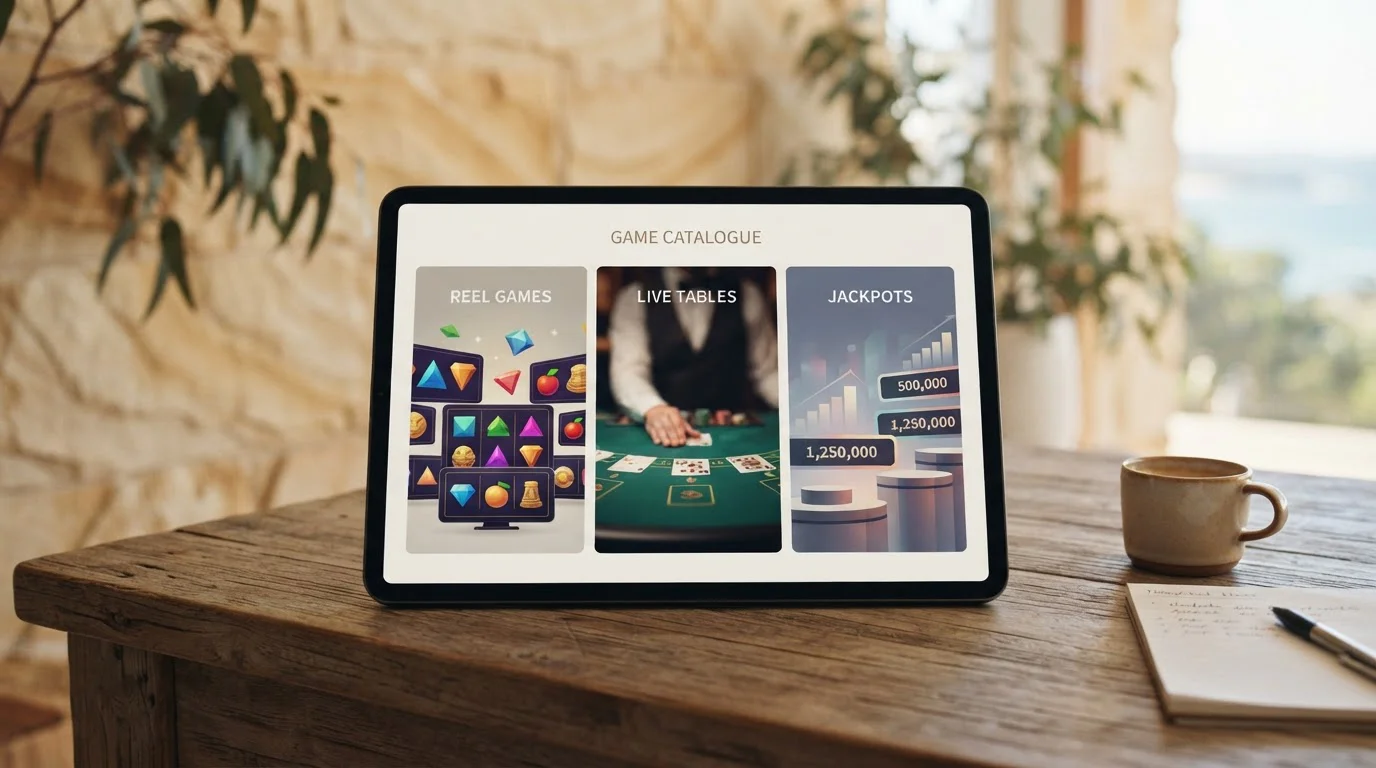
Table of Contents
Game categories across the SkyCrown lobby
SkyCrown Casino organises its lobby around slots or pokies, live casino, table games, jackpots, instant titles, bonus-buy formats and tournaments. These are navigation categories, and some titles may appear in more than one category. For example, a slot can also be labelled as a jackpot game or as a title with a bonus-purchase feature. Counting category entries as distinct games would therefore misrepresent the actual size of the catalogue.
The casino advertises more than 7,000 games in its promotional headline, while a separate counter on the Australian-language lobby displayed 13,944 titles during the recorded snapshot. The first is a rounded promotional headline; the second is a changing interface counter. Neither should be transformed into a permanent inventory guarantee. Titles can be added, removed or temporarily unavailable for technical, provider or account-specific reasons.
Pokies are the most direct way to understand the difference between catalogue breadth and meaningful choice. Two games may share bright reels and familiar symbols but differ radically in their pay tables, feature triggers, volatility and optional purchases. A tile image and title alone do not communicate those properties. The actual game information screen is the relevant place for pay rules and return figures.
- Slots and pokies: spinning-reel games with combinations, pay lines or ways-to-win systems and variable bonus mechanics.
- Live casino: streamed dealer-led tables where a player acts through an interface while the underlying table game follows its own rules.
- Table games: electronic casino formats such as roulette-style or card games with published rule sets and defined betting options.
- Jackpots: prizes triggered under a separate game or pooled jackpot structure, with prize rules specific to each title.
- Instant titles: short game rounds with outcomes determined by the individual title rather than by a shared slot mechanic.
A dedicated mobile browsing discussion explains how categories and search behave on a smaller display. The payments guide addresses the separate issue of how funds move through a casino account; neither payment speed nor the number of lobby tiles indicates how much a game is expected to return.
Where category labels overlap
A jackpot label describes a prize arrangement, not necessarily a unique game genre. Likewise, a tournament is an event or competitive overlay rather than a mathematical definition of a game. A slot presented inside a tournament remains a slot, with its ordinary pay rules plus any separate tournament terms. Those layers should be read independently.
How odds and game mathematics change the experience
Return to player, commonly shortened to RTP, is a long-run theoretical ratio for a defined version of a game. A hypothetical 96% RTP would describe an average return of 96 units for every 100 wagered over an immense number of plays under the mathematical model; it would not promise that a particular person receives 96 units. This percentage is an educational example, not a figure attributed to any SkyCrown title.
The complement of an RTP percentage is often called the theoretical house edge. It is not a fee collected as a separate line item after every spin. Instead it is built into the probability distribution and prizes. Even with identical RTP values, two titles can have different variance: one may distribute smaller wins frequently, another may produce long stretches of losses punctuated by occasional large awards.
Volatility matters because a short session is dominated by randomness rather than convergence to a theoretical average. A game may pay nothing across many rounds even when its model allows occasional large outcomes. An individual outcome is not made more likely by a preceding losing streak; the belief that a machine must now pay because it has been cold is the gambler’s fallacy.
- Identify the exact title and version shown in the lobby.
- Read the game help or pay-table panel for symbols, bonus triggers and the rules for each bet.
- Distinguish theoretical RTP from a prediction of personal results.
- Check whether side bets, extra features or bonus-purchase options alter the stake or rules.
- Treat jackpot odds and tournament reward rules as separate from ordinary line or table payouts.
A useful game comparison therefore starts with mechanics instead of a colourful thumbnail. Two games can share a theme while one uses expanding reels and the other a fixed grid; these differences affect the number and type of outcomes. Table products likewise depend on the exact rules and permitted wagers. A blackjack-style title with one set of rules cannot be assigned the return of a different version.
Why buying a bonus changes the stake
Some slots offer a direct purchase of a feature round. A purchase can cost many times the normal base stake and is not a risk-free shortcut to a profitable feature. It changes how much capital is exposed in one decision and may use a different game configuration. A purchase price belongs to the exact title and must not be inferred from the existence of a bonus-buy category in the lobby.
For a concrete session-cost illustration, imagine fifty wagers of A$2 each: the turnover is A$100, even though the account might fluctuate above and below its starting balance during those wagers. Turnover is not the same as a deposit, and cumulative wagering should not be mistaken for money recovered. This example explains exposure and does not describe a SkyCrown betting limit.
Named titles and what their formats suggest
Among the game names shown in SkyCrown’s Australian-language lobby are Sweet Bonanza 2500, Wolf Gold, Gates of Olympus Super Scatter, The Dog House Megaways 1000 and 1001 Spins. The titles identify particular products in the displayed catalogue; they are not interchangeable templates. Even within a recognisable franchise, a suffix such as “2500”, “Megaways” or “Super Scatter” can denote a materially different feature set.
A branded family name is a helpful starting point for recognition, but the particular edition decides how symbols are evaluated and how bonus rounds work. “Megaways” is associated with variable ways-to-win structures in games that implement that mechanic. An animal theme or closely related series name does not determine volatility or payout configuration.
The name Wolf Gold is an example of a familiar slot-style title, while the naming of Gates of Olympus Super Scatter points to a distinct feature-led variant. Their names alone do not reveal the real odds of triggering a feature, and any multiplier visible on a screenshot is a game element rather than a forecast. The appropriate comparison is the title-specific rules screen, including any limitations on game variants.
The title 1001 Spins also illustrates why thematic naming is a weak source for mathematical claims. A number in a title is part of branding; it is not evidence of a fixed number of granted spins, return rounds, or winning opportunities. Product categorisation should not be translated into promises about frequency or payback.
A compact comparison of formats
| Format | What defines it | Main analytical consideration |
|---|---|---|
| Pokies | Reels, combinations and features | Volatility and pay-table design |
| Live casino | Streamed dealer and table rules | Specific table rules and wager types |
| Table games | Digital rule-driven outcomes | Rule variation and betting structure |
| Jackpot games | Additional prize mechanics | Trigger conditions and prize funding |
| Instant games | Short self-contained rounds | Frequency of decisions and stake exposure |
The presence of tournaments and additional event-like sections does not alter the base rules of the games beneath them. It introduces an additional layer of eligibility, ranking or prize distribution, and an event’s terms should be kept separate from the underlying game mathematics. Casino catalogue labels are useful for orientation, but never sufficient evidence of a personal expected outcome.
Providers and the limits of category-level comparisons
SkyCrown material names Booongo in connection with Sun of Egypt 3 on a brand promotion page. That provides a concrete example of one game-provider relationship, but not a complete, currently available provider roster. It would be a mistake to turn a single named studio into a claim that every title in the lobby is supplied by it, or to assign other studios to games without source-specific support.
In casino distribution, the studio develops a game, a platform or aggregator may distribute it, and the casino presents the entry in its lobby. These roles can differ even when the interface shows one combined tile. An aggregator’s catalogue can change, and a game may be temporarily removed or replaced by a variant. The visible result is a changing list rather than a fixed printed library.
The difference matters when interpreting game rules and technical problems. A temporary loading failure is not evidence that the casino has removed an entire category. Conversely, a thumbnail surviving in an old review does not prove a title is currently playable. A rational comparison separates what the operator displays from what a particular developer’s documented rules specify.
- Game title and edition should be matched before comparing mechanics.
- Return figures belong to a specific game configuration, not to a whole provider.
- Live streams depend on connectivity and table availability in addition to underlying rules.
- A jackpot may have separate prize rules that cannot be inferred from the ordinary slot pay table.
- Mobile rendering changes presentation, not the mathematical meaning of a round.
Games with similar interfaces can also differ in how they present expenditure. A rapidly repeating instant title can create many separate stake decisions, while a live table generally follows a more visible round sequence. The speed of interaction changes how quickly turnover accumulates. It does not create a positive long-run expectation, and faster play can increase financial exposure.
Reading an unfamiliar title
The safest technical interpretation begins with the exact game name, followed by the developer and help panel when displayed. The pay table explains winning combinations and features, while the general category explains only the style of interaction. Taking a single number from an unrelated review, game version or studio can give a misleading impression of the title being discussed.
Questions about SkyCrown games
What types of games does SkyCrown show?
SkyCrown’s lobby groups pokies, live casino, table games, jackpots and instant titles, alongside bonus-buy and tournament categories.
Which SkyCrown game titles appear in its lobby?
Examples include Sweet Bonanza 2500, Wolf Gold, Gates of Olympus Super Scatter, The Dog House Megaways 1000 and 1001 Spins.
Does a game category determine its RTP?
No. RTP applies to a specific game and configuration; a category such as pokies or jackpot does not provide a single return percentage.
What does the SkyCrown game count represent?
SkyCrown advertises more than 7,000 games in a headline, while a changing lobby counter displayed 13,944 in a recorded snapshot. These are different presentations of a changing catalogue.
Is a jackpot win predictable from previous spins?
No. Previous outcomes do not make a future independent random outcome due. Jackpot mechanics depend on the particular game rules.
What the SkyCrown game catalogue tells you
SkyCrown offers a broad selection of recognisable game types and named slot variants. The lobby’s changing counter illustrates breadth, while the mathematics of a wager comes from the exact game rules rather than a category tile. RTP, volatility, extra-feature purchases and session turnover determine how different games expose money to uncertainty.